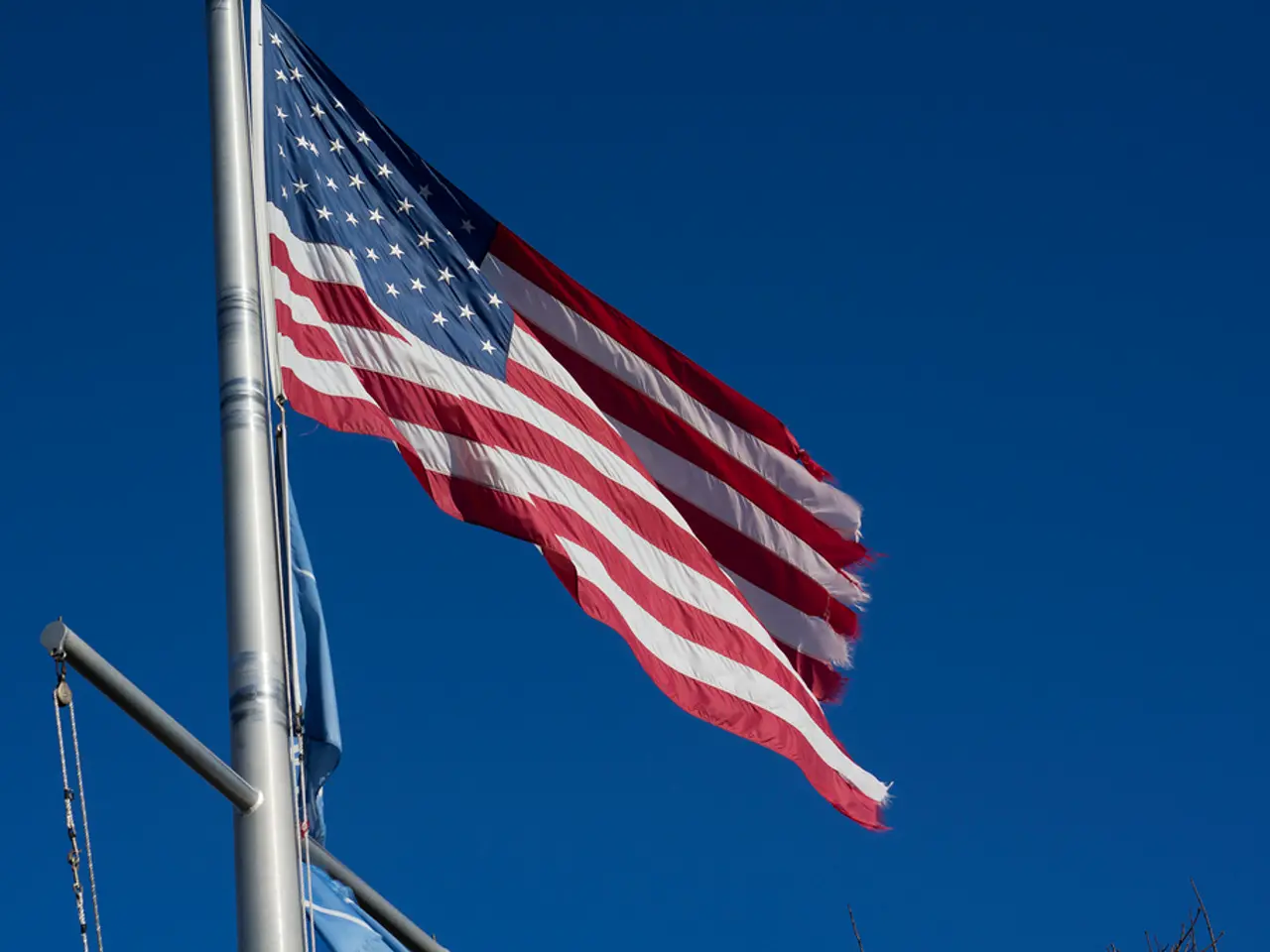
Focusing on the core values of America, as expressed by Richard Nelson, and ignoring political disagreements
Uniting Under the Stars and Stripes: The Significance of Flag Day in American History
In the land of the free and the home of the brave, Flag Day serves as a poignant reminder of the enduring symbolism of the American flag and its role in shaping the nation's identity. This patriotic holiday, celebrated on June 14, marks the adoption of the first U.S. flag by the Second Continental Congress in 1777.
A Flag's Evolution
Prior to the American Revolution, colonists flew variations of the English flag, with some colonies even creating their own banners to reflect local sentiments. The Pine Tree Flag, with the motto "An Appeal to Heaven," was flown in Massachusetts, while a rattlesnake flag bearing the phrase "Don't Tread on Me!" was popular in southern colonies.
The first official U.S. flag, established by the Flag Act of 1777, featured thirteen alternating red and white stripes and thirteen white stars arranged in a constellation pattern on a blue field. Although the story of Betsy Ross sewing the first American flag in 1776 is widely known, modern historians view it as more legend than proven fact.
As the United States expanded, so did the flag, with stars added to represent each new state while the number of stripes remained fixed at thirteen to honour the original colonies.
Symbolism and Impact on American Society
The American flag symbolizes the country's core values of liberty, unity, and resilience, mirroring the nation's founding and growth. Historical flags used during the Revolution, like the Pine Tree Flag, were early expressions of American identity, representing colonial resistance.
Flag Day, first celebrated formally in the early 20th century, is a day for remembrance of the national symbol's origins and a time for patriotic ceremonies nationwide. The flag has remained a powerful emblem in American culture, fostering national pride and often featured in civic events.
Heroes Under the Flag
During times of conflict, the American flag has become a symbol of courage and determination. Sergeant William Carney, a black American, exemplified this spirit during the Civil War when he took the U.S. flag from a mortally wounded flag bearer and did not let it touch the ground. His bravery earned him the U.S. Medal of Honor, making him the first black American to receive this prestigious award.
A Flag for All Seasons
The U.S. Constitution protects the freedom to burn the U.S. flag, despite it being considered offensive, and the freedom to assemble and wave foreign flags. This freedom, while controversial, is a testament to the democratic values the flag represents.
In recent years, the U.S. flag has been seen in unexpected places, such as the Bald Knob neighborhood, symbolizing hope, freedom, and justice for those who wave it. The flag's enduring symbolism continues to unite Americans across generations and backgrounds, fostering a shared sense of national identity.
References
- History.com Editors. (2009). Flag Day. History.com.
- The American Flag: A Visual History. (2016). Smithsonian.com.
- The Betsy Ross Flag: Myth and Reality. (2007). The Philadelphia Inquirer.
- Labor Day: The History of a Patriotic Holiday. (2018). History.com.
- The Unofficial History of the American Flag. (2013). Mental Floss.
- Beyond its iconic status in history, the American flag plays a significant role in contemporary American society, serving as an influential symbol in government, education, business, and entertainment.
- In the realm of politics, the flag is a powerful tool, shaping public opinion during elections and serving as a symbol of national unity.
- In the realm of lifestyle, people proudly display their flags in outdoor-living spaces, reflecting their family-dynamics and love for home-and-garden.
- The flag's power extends to the sports world, where it is frequently displayed during competitions, symbolising team spirit, camaraderie, and healthy competition.
- Interestingly, some businesses have also embraced sports-betting as a way to engage fans, using the flag to symbolize their patriotic approach to sports.
- Despite its universally positive connotations, the flag serves as a stark reminder of war-and-conflicts, embodying the courage and resilience of soldiers who fought under its banner.
- In the context of policy-and-legislation, the protection of the freedom to burn the American flag, as stated in the Constitution, highlights the principle of civil liberties amidst controversial debates.
- Moreover, the flag has been used to protest crimes and injustices, bringing attention to cases of accidents, fires, and other incidents that challenge society.
- The American flag, a beacon of hope and unity, continues to reflect and shape the general-news narrative, offering a shared icon for conversation on relationships, lifestyle, and current events.